

I’m an avid reader of books, ~300 in the past 5 years. As a biotech VC investor and former PhD cancer biologist, I’m deeply passionate about biotech, science, and medicine. I’ve spent years searching for a comprehensive list of biotech books. It doesn’t exist.
After reading 132 books about biotech, medicine, and drug development, I’ve built this biotech reading list I wish existed. Every book is categorized, rated, and summarized. Many have my personal annotations, many additional annotations are upcoming. I will continue to update this list as I read more books in 2026 (and beyond). Also fill in more personal comments on books I already read.
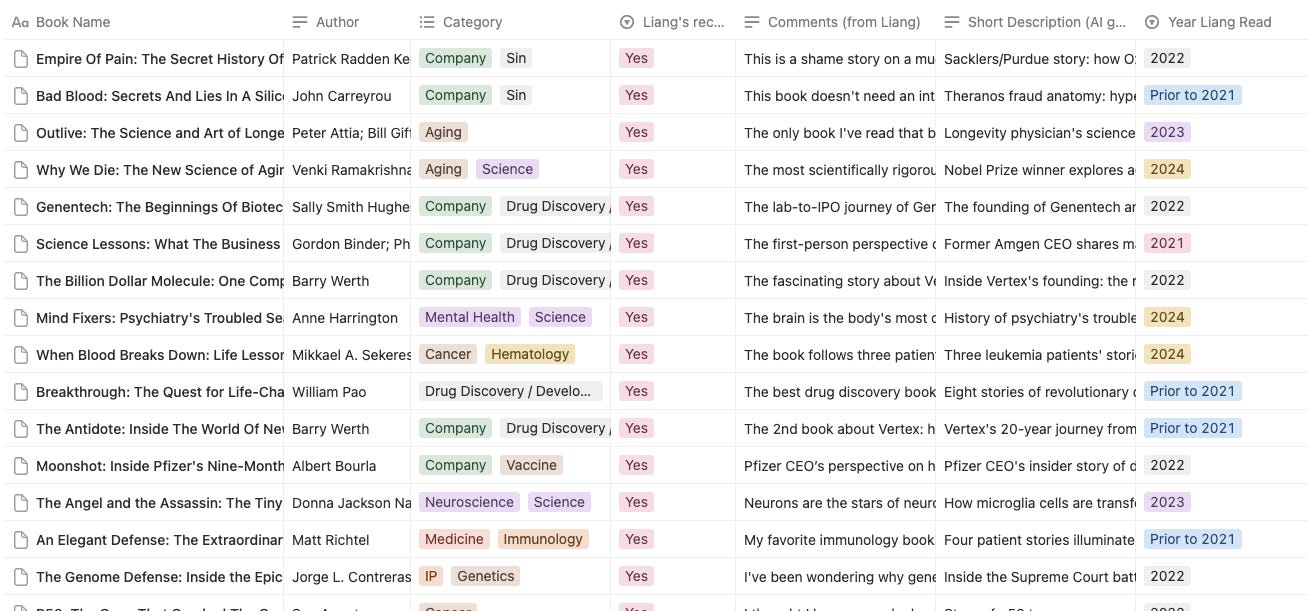
(just a screenshot, full list below!)
How I Select and Rate Books
The Selection Process
Since reading (or listening to) a book is a commitment, I’m selective before I start reading. Every book on this list passed through at least one filter:
Recommendations from friends or network
Curated book lists from sources I trust
My favorite bookstore: Brookline Booksmith has my favorite medicine and science shelves and I visited often for inspirations
Bestseller lists
Liang’s recommendation
You will notice a “Liang’s recommendation” column. Recommendation from me means either:
Taught me something inspiring — it changed how I think about a topic, a company, or the industry
Is highly informational for getting an overview — it gives someone new to a space a strong foundation
Please note everyone’s book taste is highly personal.
The Full List
By the Numbers
Total books read = 132
Liang’s recommendation = 82
Top labels: Science (35), Medicine (27), Drug Discovery / Development (20), Chinese (13), Company (12), Neuroscience (11), Immunology (9), Healthcare System (9), Cancer (9), Business (8), Mental Health (7), Rare Disease (6), People (6), Genetics (6)
A few quick write ups (and more to come)
📈 7 Biotech Company Stories
Genentech: The Beginnings of Biotech (Sally Smith Hughes). The lab-to-IPO journey of Genentech in its early days, marking the start of the biotech revolution. It’s a fascinating story, and the strategic aspect is applicable to biotech entrepreneurship today. A must-read!
The Billion Dollar Molecule (Barry Werth). The fascinating story about Vertex early days. The mission to use rational drug design to revolutionize the industry, the journey to get FK506, the complicated relationship with Stuart Schreiber…
The Antidote (Barry Werth). The 2nd book about Vertex: how it made and launch the HCV drug to become a commercial-stage biotech, the Aurora deal and the making of the CF franchise, etc. Same company, different stages and different flavors.
Science Lessons (Gordon Binder). The first-person perspective of the 1988-early 2000 Amgen from the CEO. The journey to get 2 blockbuster products Epogen and Neupogen, the partnership with Kirin, the IPO process, etc. Also a great book!
A Rare Breed (Levine & Maher). A book about Biomarin’s history, its journey on building a rare-disease franchise: partnership with Genzyme, product planning and launching, good and bad BD deals, etc. I like this book a lot, a hidden gem!
Bad Blood (John Carreyrou). This book doesn’t need an introduction. The biggest take home message I learned: you need to be humbled by the science, no “fake it till make it” in biotech.
Empire of Pain (Patrick Radden Keefe). This is a shame story on a much larger scale. A great book on Purdue Pharma, how its unethical “indication expansion strategy” caused the opioid crisis, and the Sackler family behind it.
🧬 8 Books about Cancer
The Emperor of All Maladies (Siddhartha Mukherjee). The definitive biography of cancer. One book you should read before everything below.
The Philadelphia Chromosome (Jessica Wapner). Great book reviewing the scientific discovery of the Philadelphia chromosome and BCR-ABL fusion as cancer driver, as well as Brian Druker’s perseverance behind the Imatinib success story.
Her-2 (Robert Bazell). The discovery story behind Herceptin—science, business, and patient advocacy colliding.
The Breakthrough (Charles Graeber). Cancer Immunotherapy has transformed cancer cares in the past 10 years, and this book depicts the history of the field. I especially like James Allison’s story in the book.
The Immortal Life of Henrietta Lacks (Rebecca Skloot). The story behind HeLa cells: consent, race, and the hidden history of modern biomedicine.
P53: The Gene That Cracked the Cancer Code (Sue Armstrong). I thought I knew enough about the most important tumor suppressor gene p53, until I read this book about the history of the field, and researchers’ stories behind classical papers.
Cancerland (David Scadden). A Harvard oncologist weaves patient stories with cancer science.
Malignant (Vinay Prasad). A contrarian take: how bad policy and weak evidence harm cancer patients.
💊 4 Drug Discovery Stories
Breakthrough: The Quest for Life-Changing Medicines (William Pao). The best drug discovery book I’ve read. William Pao, a former Pfizer/Roche executive, details six drug development cases: from century-old paracetamol to recent blockbusters (osimertinib, alpelisib, lenacapavir, risdiplam) to the first approved CRISPR therapy. The author interviewed many project team members, achieving both depth and breadth. A great book for anyone in the biotech industry!
For Blood and Money (Nathan Vardi). A riveting drug discovery story about how two multi-billion-dollar BTK inhibitors went from a small pharma’s discard pile and Merck’s $1,000 sell-off to eventual big pharma acquisitions through biotech maneuvering.
Magic Pill (Johann Hari). A book about the history of GLP-1 “miracle drugs.” The author, a journalist, starts from personal experience, covers the scientific and medical journey of GLP-1 development, and discusses the origins of the Western obesity pandemic and the societal impact of the GLP-1 wave. Thought-provoking.
The Philadelphia Chromosome (Jessica Wapner). Great book reviewing the scientific discovery of the Philadelphia chromosome and BCR-ABL fusion as cancer driver, as well as Brian Druker’s perseverance behind the Imatinib success story.
I’m working on longer reviews for many of these books: more of my personal takes on why I like this book and how it shaped my thinking.
Are there any books you like but not on this list? Please leave it in comment or let me know!
What’s upcoming on this blog ?
Some new pieces are in the foundry & coming soon. If any sounds interesting, consider subscribing!
I listened to 202 episodes of podcasts (mostly) on AI in 2025: here are the key learnings and my favorite episodes
I used ChatGPT to buy a house—here's the framework that actually worked (with some helpful prompts)
3 waves of innovations in oncology, and where the 4th wave is going
This is an incredible advice to the field, thank you! As a physician-scientist, I wish more people appreciated how much better our thinking gets when we read across domains (mechanism → trials → systems → incentives → ethics). Your selection/rating framework is exactly what makes a list like this useful rather than overwhelming, and the “quick write-ups” are gold for trainees trying to build taste and pattern-recognition in biotech. 
Clinically, I also love the implicit lesson here: there’s no “fake it till you make it” in medicine/biotech;the costs of weak evidence, bad incentives, or narrative-driven decision-making eventually land on patients. Seeing books like Bad Blood and Empire of Pain alongside discovery stories is a powerful reminder that rigor and humility are part of patient safety.
This is a great resource, thank you!