

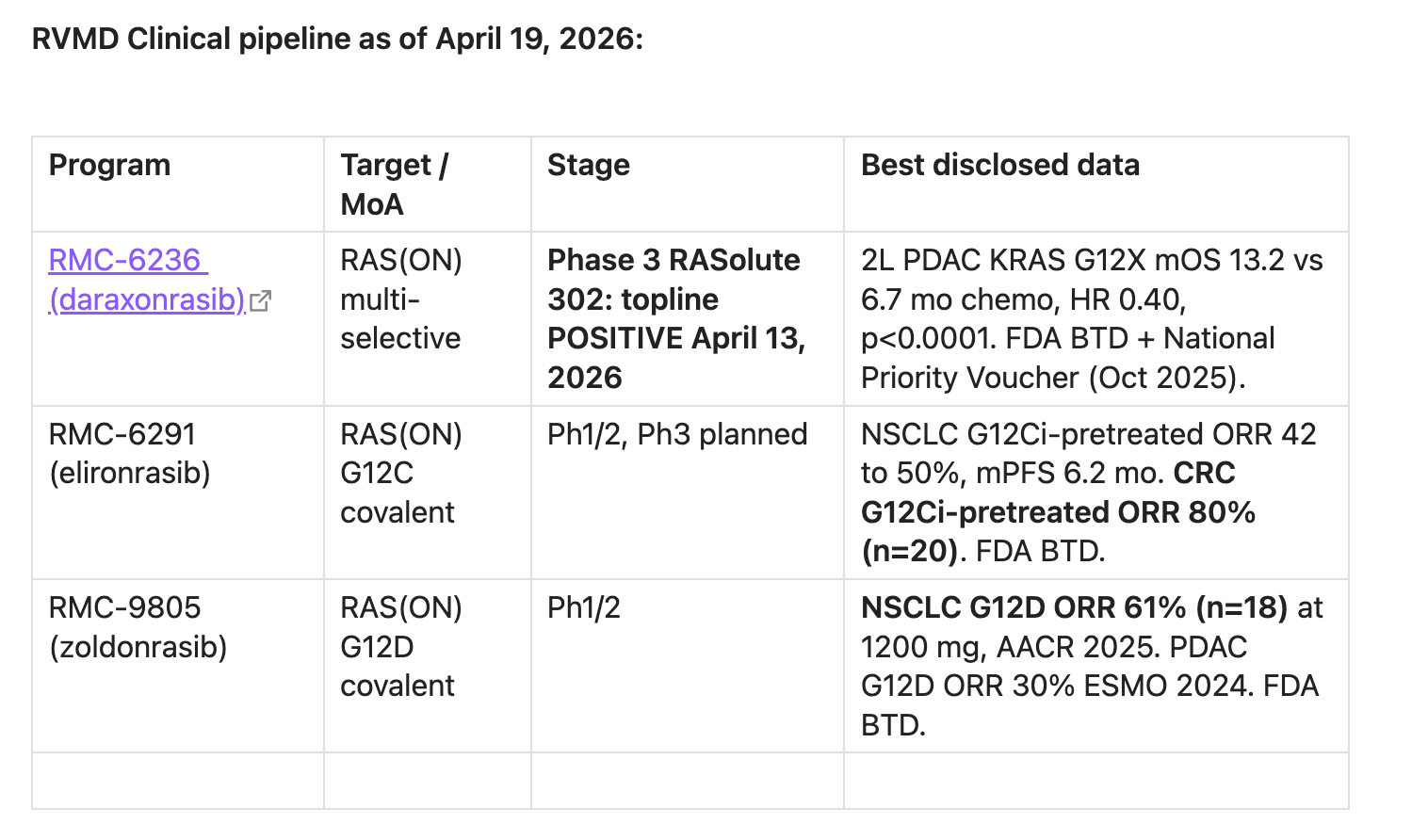
On April 13, Revolution Medicines reported topline data from RASolute 302, the Phase 3 trial of pan-RAS inhibitor daraxonrasib monotherapy against chemotherapy in 2L metastatic pancreatic cancer patients with KRAS G12X mutations. Median OS was 13.2 months for daraxonrasib versus 6.7 for chemotherapy, with a hazard ratio of 0.40 and p less than 0.0001. That is one of the biggest oncology victories in recent years, especially for PDAC — a disease where little progress has been made in the past decade, as I wrote in The Decade in Oncology.
KRAS was the main topic of my PhD qualifying exam in 2018, and I have been closely watching KRAS drug development since then. My first excitement came in 2019, when Amgen and Mirati both presented clinical data on KRAS G12C inhibitors showing real response. Then came the Amgen vs. Mirati battle that ended with both drugs approved but clinically underwhelming. Then the story of Revolution Medicines and pan-RAS(ON) glue. Then the plethora of KRAS mutation-selective and broad-acting assets from both the US and China in recent years.
I recently analyzed 8,491 KRAS-related conference abstracts from my internal AACR, ASCO, ESMO, and Triple Meeting collection covering 2016 to 2026, plus the 6 most recent KRAS reviews in the last 2 years. More importantly, 8 years of personal passion following the quest to drug the most deadly cancer mutation.
I want to take a stab to depict the chronography of drugging KRAS across the past 40 years.
Here the journey begins.
Era 1. Discovery (1982 to 1996)
From Harvey’s rat sarcoma to the undruggable consensus
Human KRAS (and HRAS) were cloned in 1982–83 as cellular homologs of the Harvey and Kirsten rat sarcoma viruses, pulled out of transforming activity in bladder, lung, and colon carcinoma lines by the Weinberg, Wigler, and Barbacid labs. NRAS followed in 1983 from a neuroblastoma line and has no viral counterpart. By the mid-1980s the three-member RAS family was the first broadly validated human oncogene family, activated by missense mutations at codons 12, 13, and 61. Prevalences have held up across four decades of sequencing: KRAS mutations in ~90% of pancreatic ductal adenocarcinoma (PDAC), ~40% of colorectal cancer (CRC), and ~30% of non-small-cell lung cancer (NSCLC, almost entirely adenocarcinoma).
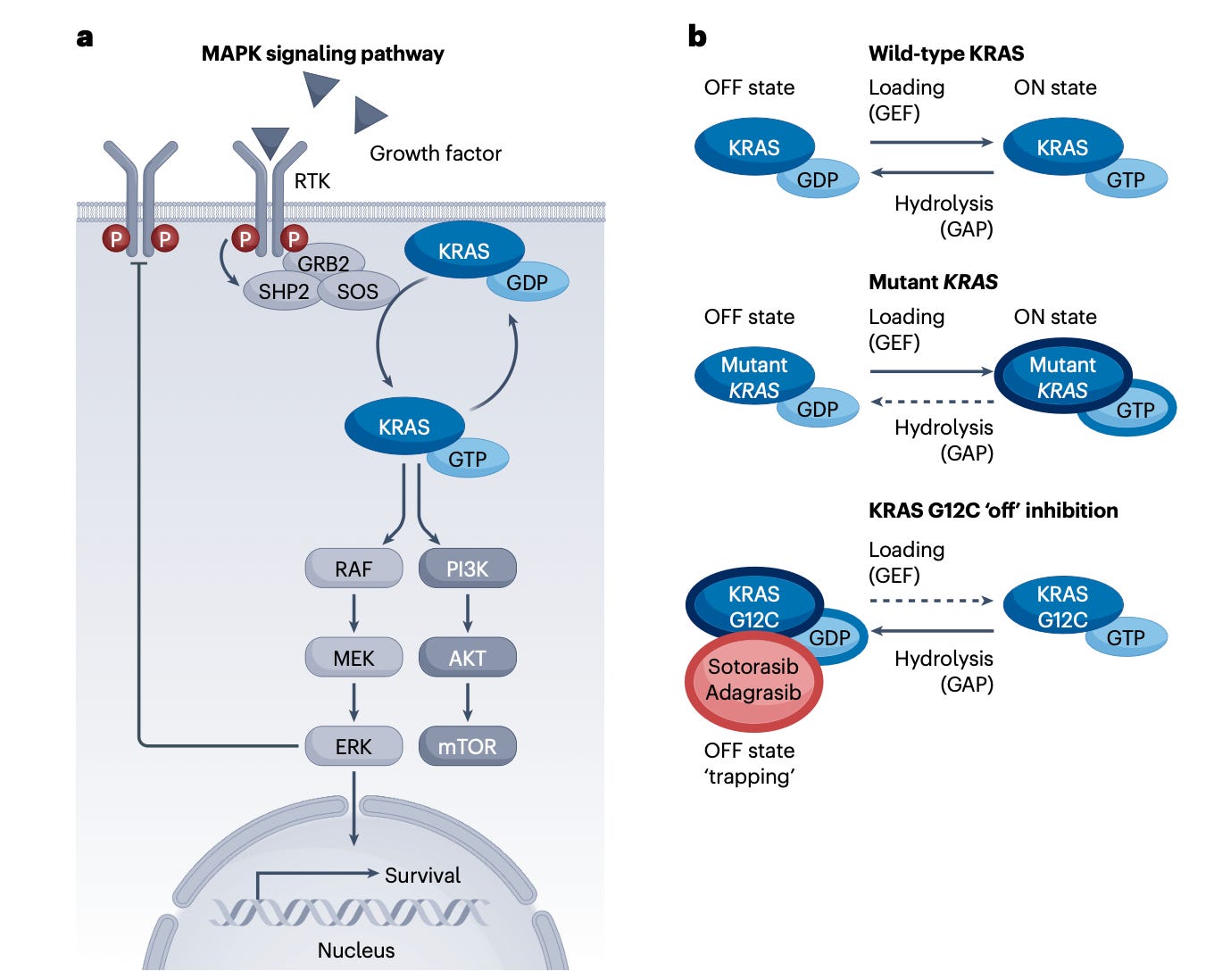
The biology locked in fast. RAS is a small GTPase cycling between a GTP-bound active state that engages RAF, PI3K, and RalGDS and a GDP-bound inactive state that does not. Oncogenic mutations at codons 12, 13, and 61 slow GTP hydrolysis and bias RAS toward the active state. Upstream guanine exchange factors like SOS1 reload GTP; downstream GTPase-activating proteins like NF1 hydrolyze it back. The whole thing is a molecular switch, stuck on in >50% of all human cancer.
The pharmacology moves much slower. By the mid-1990s three structural features had largely convinced the field that RAS was undruggable. RAS binds GTP with picomolar affinity at cellular GTP concentrations, which rules out a competitive nucleotide-pocket inhibitor. The effector interface is flat and largely featureless. And RAS requires lipid anchoring at its CAAX motif, but the modifying enzymes sit upstream, not on RAS itself. The target was described, with only partial irony, as the Mount Everest of cancer research, as mentioned Isermann and colleagues’ 2024 Trends in Cancer review
Era 2. The dark age of peripheral attempts (1996 to 2012)
Everything we tried that did not work
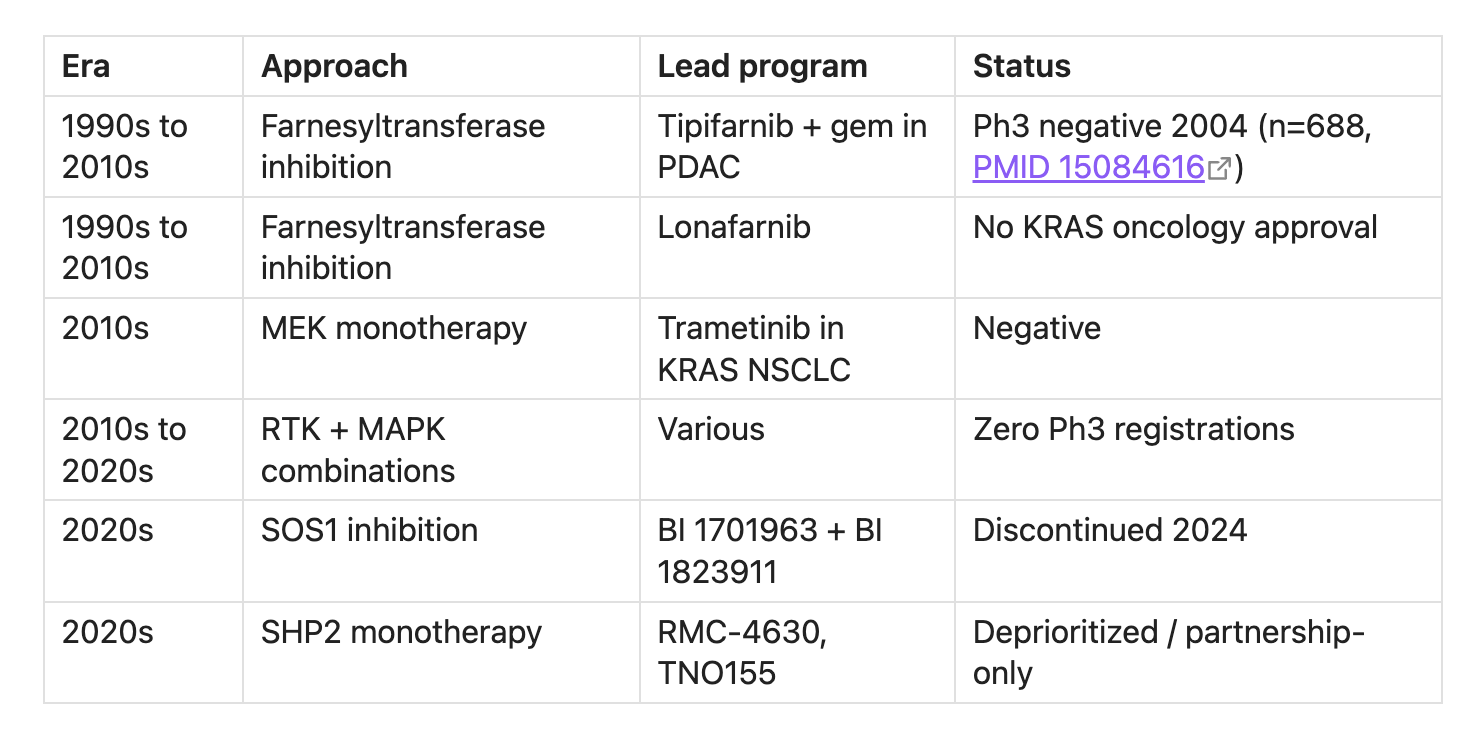
The shape of this era is that if you cannot drug RAS directly, you try to drug everything around it. Three schools of failure emerged.
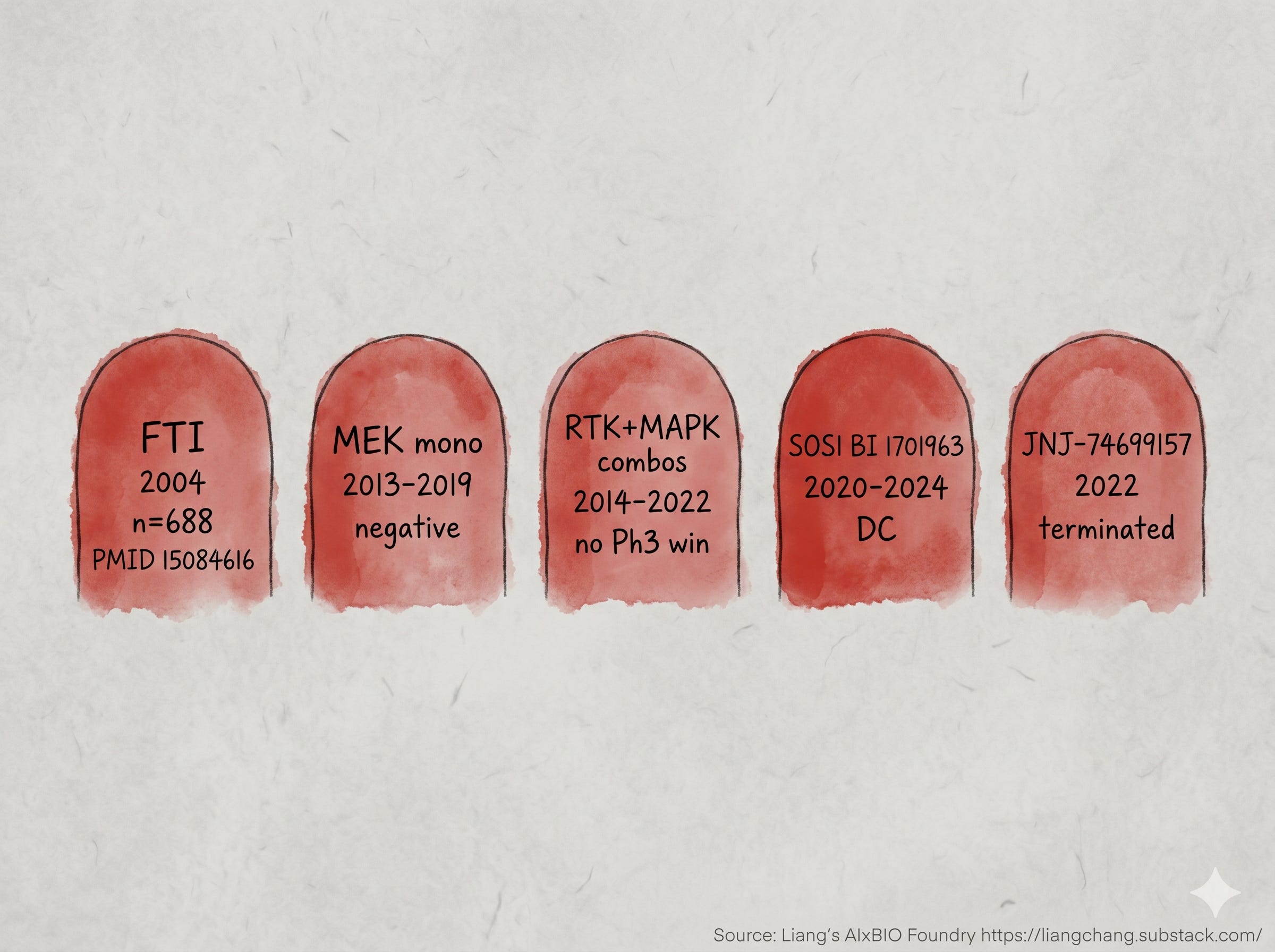
Farnesyltransferase inhibition, the farnesyl mirage. RAS needs a farnesyl lipid at its CAAX motif to localize to the membrane and signal. Block farnesyltransferase, the argument went, and you denervate RAS. Tipifarnib (Janssen) and lonafarnib (Schering-Plough) were developed into Phase 3 in the late 1990s and early 2000s across pancreatic cancer, CRC, and AML. The most informative failure was Van Cutsem 2004: 688 patients, tipifarnib plus gemcitabine versus gemcitabine alone in advanced pancreatic cancer, no OS benefit, no PFS benefit, no ORR benefit. By the mid-2000s the mechanism of failure was understood: when farnesyltransferase is blocked, KRAS and NRAS accept a 20-carbon geranylgeranyl lipid via GGTase-I and traffic to the membrane fine.
MEK and ERK monotherapy, the pathway-adjacent wager. If you cannot drug RAS, drug what RAS does. Trametinib monotherapy in KRAS-mutant NSCLC failed. Single-agent MEK inhibition in KRAS-mutant CRC failed. The retrospective explanation is rapid feedback reactivation of ERK through loss of negative regulation at the RTK layer.
SHP2 and SOS1, the recent echo. The most recent version of the same wager. SHP2 inhibitors (RMC-4630 at RVMD, TNO155 at Novartis, JAB-3312 at Jacobio) and SOS1 inhibitors (BI 1701963 at Boehringer) work upstream of RAS. Boehringer discontinued both BI 1701963 and BI 1823911 in late 2024, retiring a decade of SOS1-plus-G12Ci combination work. Jacobio’s JAB-3312 survives specifically as a combination partner for glecirasib, which is the compromise position: SHP2 not as monotherapy but as the thing that lets you push an mutation-selective KRAS inhibitor harder.
RTK-plus-MAPK combinations, the kitchen sink. MEK plus EGFR, MEK plus IGF1R, MEK plus FGFR, MEK plus PI3K. None delivered a Phase 3 registrational readout in KRAS-mutant disease. Erasca’s May 2024 pivot away from ERAS-007 and ERAS-801 toward pan-RAS molecular glues is the 2024 epitaph for the pathway-adjacent era.
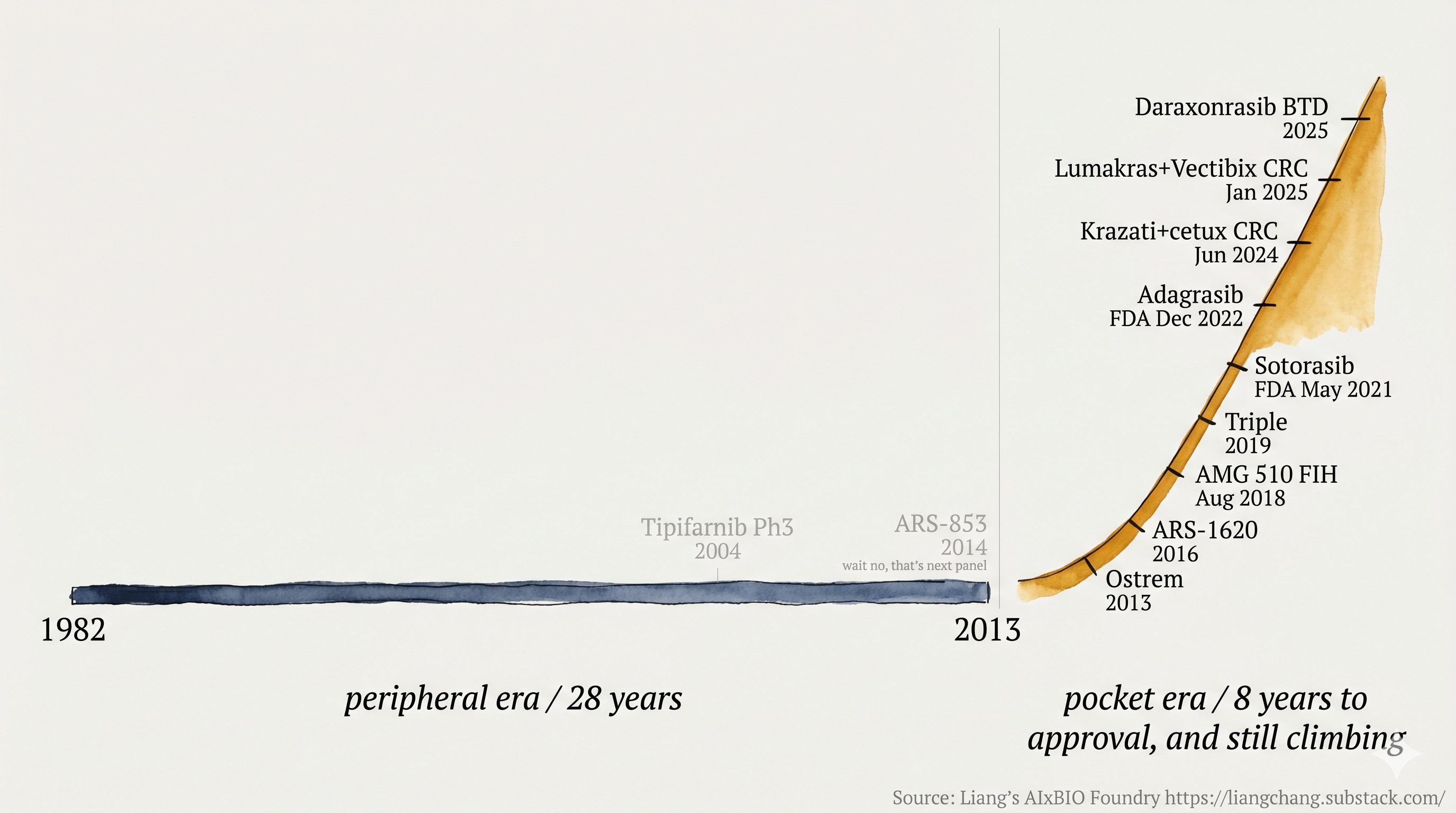
By 2012 there was no approved KRAS-targeted drug, and a broad consensus that the target would remain undruggable.
Every program outside the pocket was, in effect, a bet that RAS does not have to be the target. That bet has no success.
Era 3. The switch-II pocket (2013 to 2022)
Shokat, Amgen, Mirati, and the G12C race
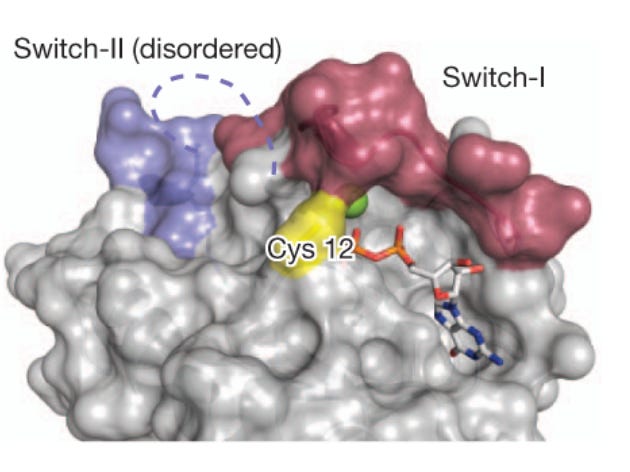
In late 2013, Kevan Shokat et al. at UCSF published a paper in Nature showing that a covalent small-molecule fragment could trap KRAS G12C in the GDP-bound OFF state by reacting with the mutant cysteine through a previously invisible allosteric pocket. They called it switch II. The pocket is not visible in any crystal structure solved before 2013; it opens only in the OFF state, after GTP has been hydrolyzed and phosphate has dissociated. Cysteine-12 is the nucleophile that lets you catch it. The compound was a tool, not a drug candidate. But it was the proof that a pocket existed.
That paper changed the consensus inside of twelve months.
Araxes Pharma was founded February 27, 2013 as the first public affiliate of Wellspring Biosciences LLC, with Shokat and Frank McCormick as scientific founders. Their lead G12C asset, ARS-3248, was out-licensed to Janssen as JNJ-74699157. That program terminated in 2022 in The Oncologist with ten patients dosed, skeletal muscle CPK elevation at 100 and 200 mg, and the sentence “no future development planned.” First G12C failure in the peer-reviewed record.
The Amgen vs. Mirati race
Two companies, two different origin paths to a G12C covalent, two different competitive playbooks.
Mirati selected MRTX849 as its clinical lead on November 13, 2017 through a joint discovery with Array BioPharma. Amgen opened AMG 510 first-in-human on August 8, 2018 through a fully internal program that built on Shokat’s Switch II Pocket and ARS-1620 quinazoline scaffold. By the critical moment, Amgen had a running trial and Mirati had a lead compound.
The fall of 2019 head-to-head. Amgen posted the first clinical signal at ESMO 2019 Barcelona on September 28, 2019: 54% ORR in KRAS G12C NSCLC at 960 mg. It was the paradigm-breaking abstract of the decade. A month later at the AACR-NCI-EORTC Triple Meeting in Boston, Amgen brought updated AMG 510 data (Abstract 4455), Mirati reported 3 of 12 NSCLC partial responses for MRTX849, Boehringer’s SOS1 inhibitor BI-3406 debuted, and Revolution Medicines’ tri-complex platform debuted quietly. Four programs, one short cycle. The Triple 2019 abstract cycle is the single densest KRAS week, showing the promise that KRAS (at a least a small fraction of mutation) could be druggable.
Amgen’s Phase 1/2 CodeBreaK 100 eventually reported ORR 37.1% and mPFS 6.8 months in G12C NSCLC (Hong NEJM 2020). Mirati’s KRYSTAL-1 Phase 2 NSCLC cohort reported ORR 42.9% and mPFS 6.5 months (Jänne NEJM 2022). Roughly the same number.
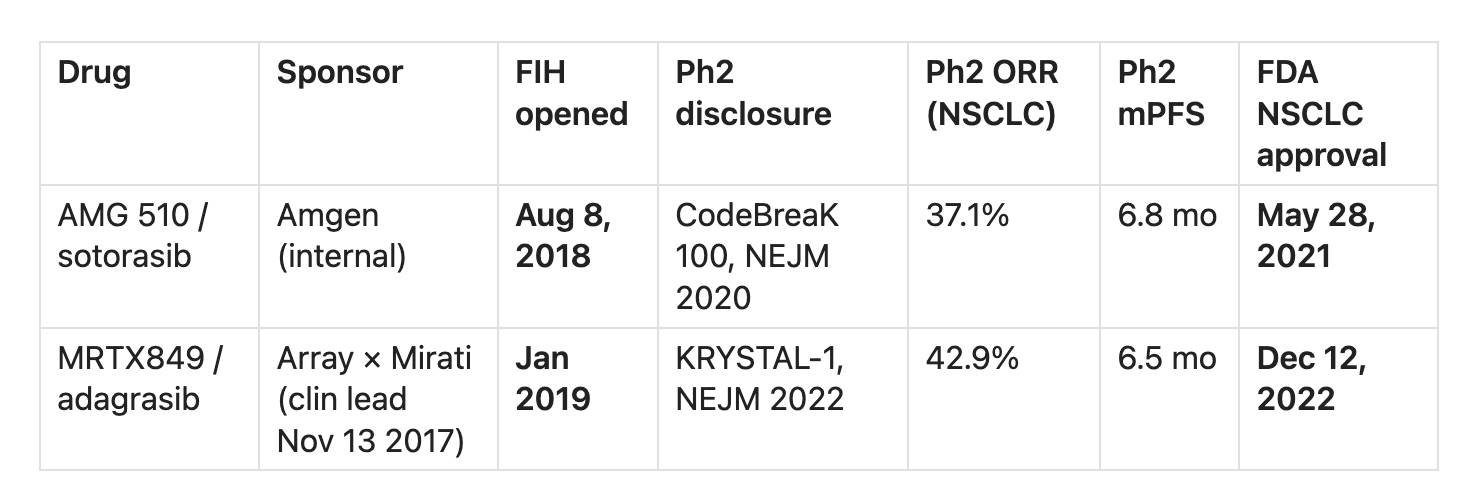
That is a 19-month lead for Amgen in NSCLC approval, which in retrospect looks smaller than it felt in 2020 because Mirati closed the gap on a different vector.
The 2024 CRC inversion. Mirati / BMS delivered the first combination-therapy KRAS approval in colorectal cancer. ESMO 2021 LBA6 showed KRYSTAL-1 CRC cohort ORR 22% for adagrasib monotherapy, climbing to 43% in combination with cetuximab. That 2021 observation fed directly into KRYSTAL-10 Phase 3, which delivered positive PFS/ORR at the 2024 ASCO plenary and earned FDA approval for adagrasib plus cetuximab in G12C mCRC on June 21, 2024. Amgen’s CodeBreaK 300, sotorasib plus panitumumab in chemorefractory G12C CRC, reported ORR 26.4% (960 mg arm) versus 5.7% (240 mg) versus 0% standard of care at ESMO 2023 LBA10, and translated to FDA approval on January 16, 2025. In CRC, Mirati/BMS beat Amgen by roughly seven months. BMS closed the Mirati acquisition in January 2024 for $5.8B, roughly bracketing the CRC approval decision.
The confirmatory regulatory reckoning. CodeBreaK 200, the registrational Phase 3 for sotorasib in 2L G12C NSCLC versus docetaxel, reported mPFS 5.6 vs 4.5 mo (HR 0.66) but failed to show statistically significant OS benefit at ASCO 2023. The FDA declined to convert sotorasib’s accelerated NSCLC approval to full approval in 2024 and requested additional Phase 3 monotherapy data by February 2028. KRYSTAL-12 fared better at the 2024 ASCO plenary: mPFS 5.5 vs 3.8 mo (HR 0.58), ORR 32 vs 9%. Both pieces of data reinforce the same observation: the 2L NSCLC G12Ci monotherapy number is modest.
Neither drug won the benchmark
And here the era self-critiques. Approvals are not efficacy ceilings, and the Era 3 drugs have delivered approvals that appear, in the 2L NSCLC setting where they face direct biomarker-matched comparators, incremental rather than transformative.
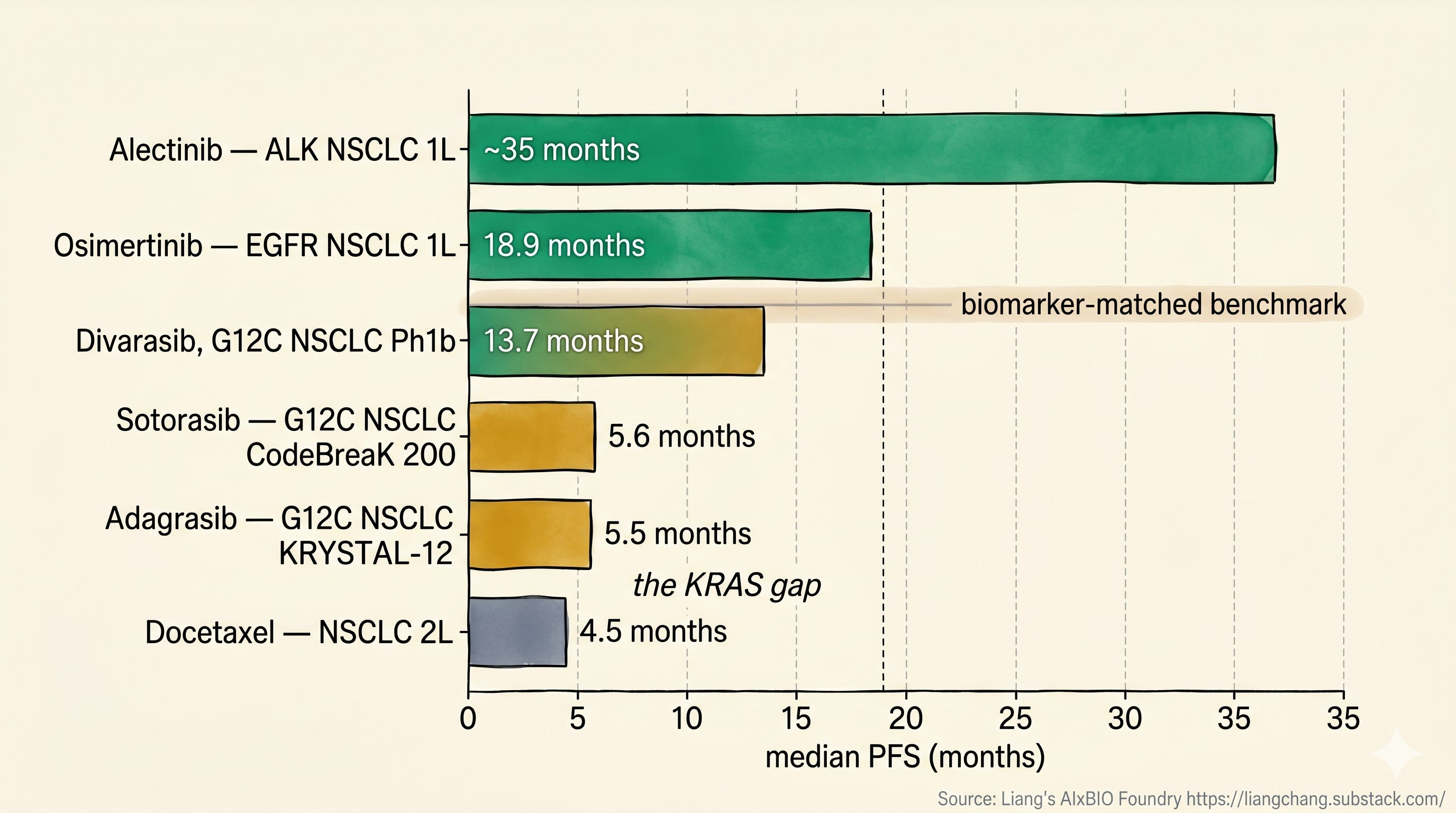
The numbers tell a straightforward analyst story. Against docetaxel, sotorasib’s 5.6-month mPFS is ~1.1 months of absolute improvement, and adagrasib’s is ~1.7 months. Against the 2L biomarker-matched comparators that clinicians actually reach for in EGFR and ALK patients, KRAS G12Ci monotherapy sits roughly 4 to 5 months below.
Tumor selectivity compounds the issue
Same drug, same mutation, three different cancers’ worth of response. Singhal, Li, and O’Reilly lay out the sotorasib monotherapy gradient: ORR 41% in G12C NSCLC, 21% in G12C PDAC, 9.7% in G12C CRC. The mechanism in CRC is adaptive. High baseline RTK expression drives EGFR-mediated rebound phosphorylation of ERK within 24 to 72 hours of G12C monotherapy. Combine a G12C inhibitor with an EGFR antibody and the thermostat breaks. KRYSTAL-10 and CodeBreaK 300 together established combination as the mechanism in CRC.
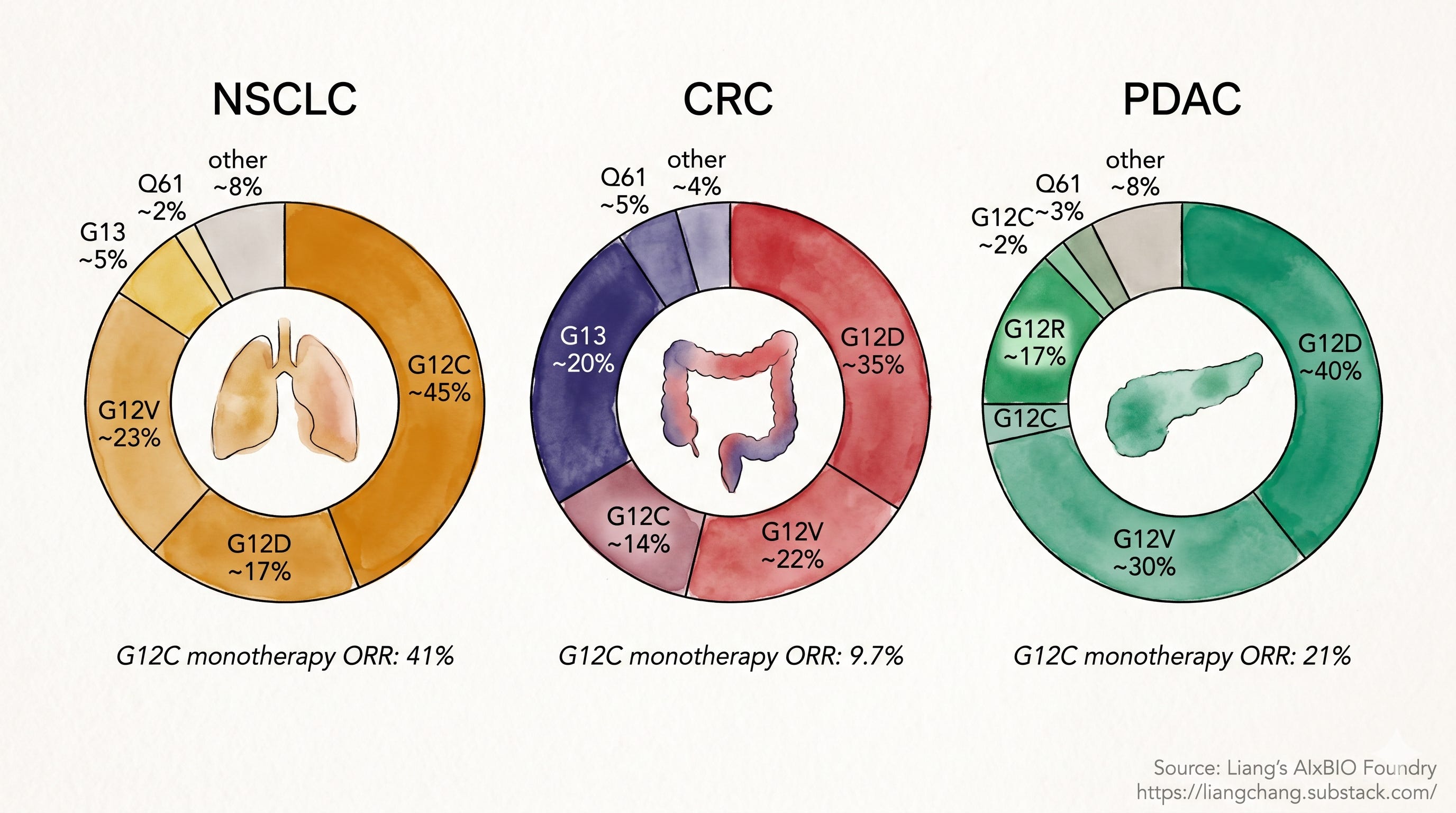
The CRC lesson has a clean analog in vemurafenib for BRAF V600E CRC, which works as monotherapy in melanoma and rebounds via EGFR within days in CRC, where it requires cetuximab plus a MEK inhibitor. The KRAS story in CRC is the same mechanism on a different target, rediscovered 15 years later. PDAC is different again. It is not just EGFR but the full pan-ERBB family, plus the desmoplastic stroma, plus metabolic cooperation with cancer-associated fibroblasts, plus the Treg/MDSC/M2-macrophage-driven cold-immune environment. Monotherapy G12Ci in PDAC was unlikely to work under any realistic assumption.
By the end of Era 3, four G12C drugs were globally approved with allelic reach to roughly 14% of NSCLC, 3% of CRC, and 2% of PDAC. The largest KRAS-driven cancers by mutation prevalence, G12D in PDAC and CRC, G12V, G13, and Q61, were untouched in the clinic. The era is the beginning, not the ending.
Era 4. The RAS(ON) glue era: Revolution Medicines (2012 to 2026)
A different pocket, a different state, a different company, and a contrarian bet that the field did not reward until 2023
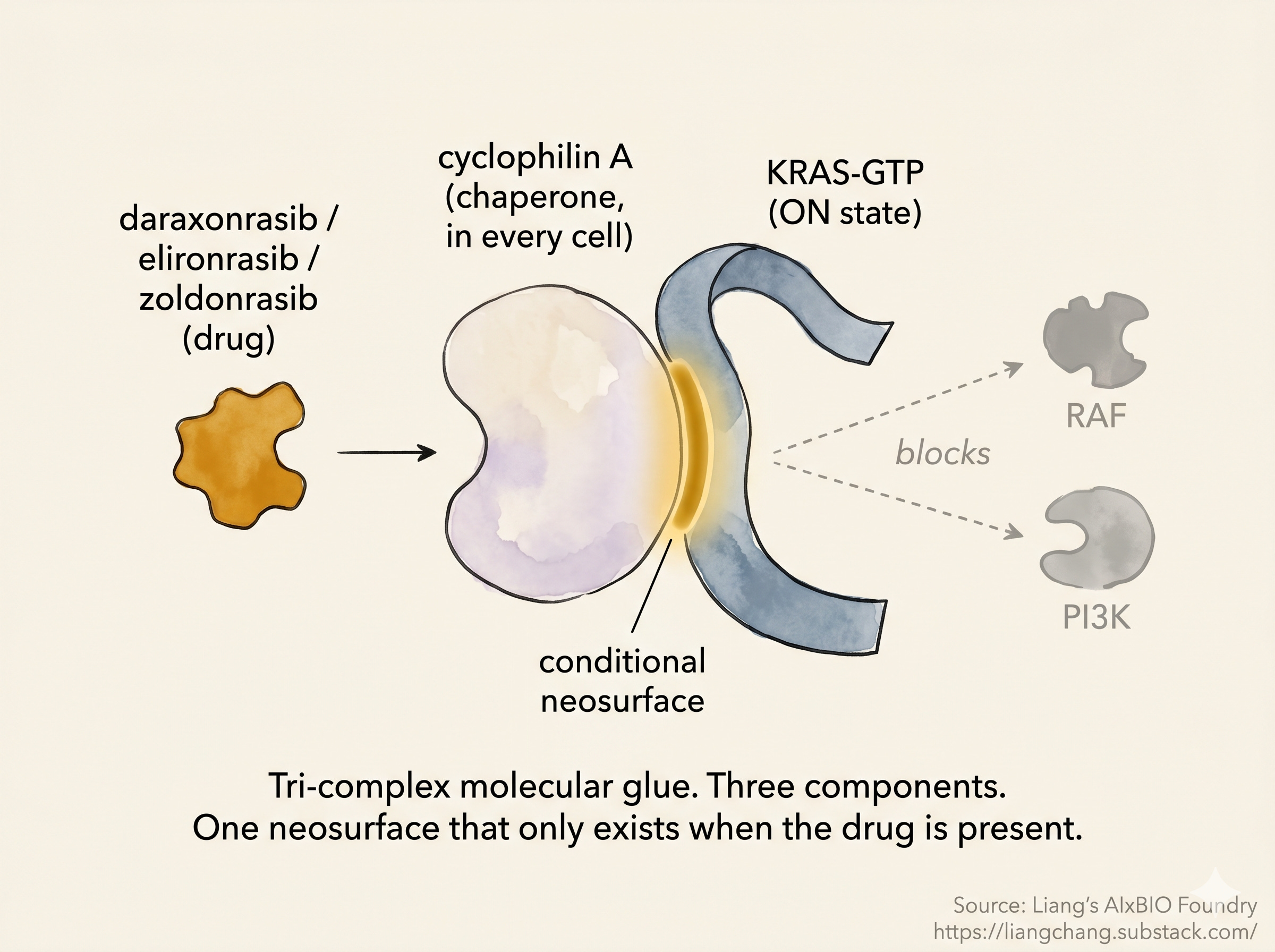
The mechanism is structurally orthogonal to the Shokat pocket. In Era 3 drugs, the small molecule binds KRAS directly in the GDP-bound OFF state, covalently locks it via cysteine-12, and sterically blocks effector recruitment. In Era 4 drugs, the small molecule does not bind KRAS alone. It binds cyclophilin A, a peptidyl-prolyl isomerase chaperone that every human cell carries in abundance. The cyclophilin-drug binary complex then engages a neosurface on KRAS-GTP (the ON state) that does not exist on free cyclophilin A or free KRAS alone, and sterically blocks effector binding.
This is a molecular glue. Specifically, a tri-complex molecular glue, where the 3 components are drug, chaperone, and oncoprotein.
The company map. Revolution Medicines is not one story. It is two biotechs welded together in October 2018.
Revolution Medicines was incorporated in 2014 and publicly launched in February 2015 with a $45M Series A from Third Rock Ventures. The founding thesis was not RAS; it was natural-product-inspired chemistry. Scientific founders were Martin Burke (Illinois, iterative cross-coupling) and David Pompliano (former Merck and GSK infectious-disease chemistry lead). Between 2015 and 2018 RVMD was primarily a SHP2 company (RMC-4630), which became a $50M-upfront July 2018 collaboration with Sanofi that Sanofi terminated in December 2022.
Warp Drive Bio was launched in January 2012 out of Third Rock Ventures with $125M committed and co-funded by Sanofi and Greylock Partners. Founders: Gregory Verdine (Harvard, stapled peptides), George Church (Harvard Medical School genetics), and James Wells (UCSF pharmaceutical chemistry). Wells, for readers paying attention to the author list of Ostrem et al. 2013, is co-senior on the paper that kicked off the Shokat pocket. Wells is on both sides of the KRAS story. The original Warp Drive thesis was a genomic search engine for natural-product scaffolds mining microbial genomes, not KRAS. By 2014 Warp Drive was pivoting toward natural-product molecular glues under Verdine as CEO, originally FKBP-targeted and later cyclophilin A. The core IP on the SMART platform (sanglifehrin-derived macrocycles) was filed during the Warp Drive years.
The acquisition was announced October 16, 2018 and closed October 24, 2018 for ~$87.8M. Sanofi converted Warp Drive equity into RVMD shares. Warp Drive’s antibiotic / genome-mining platform went separately to Ginkgo Bioworks in May 2019. Ginkgo got the search engine; RVMD got the oncology SMART platform and the CypA glue chemistry.
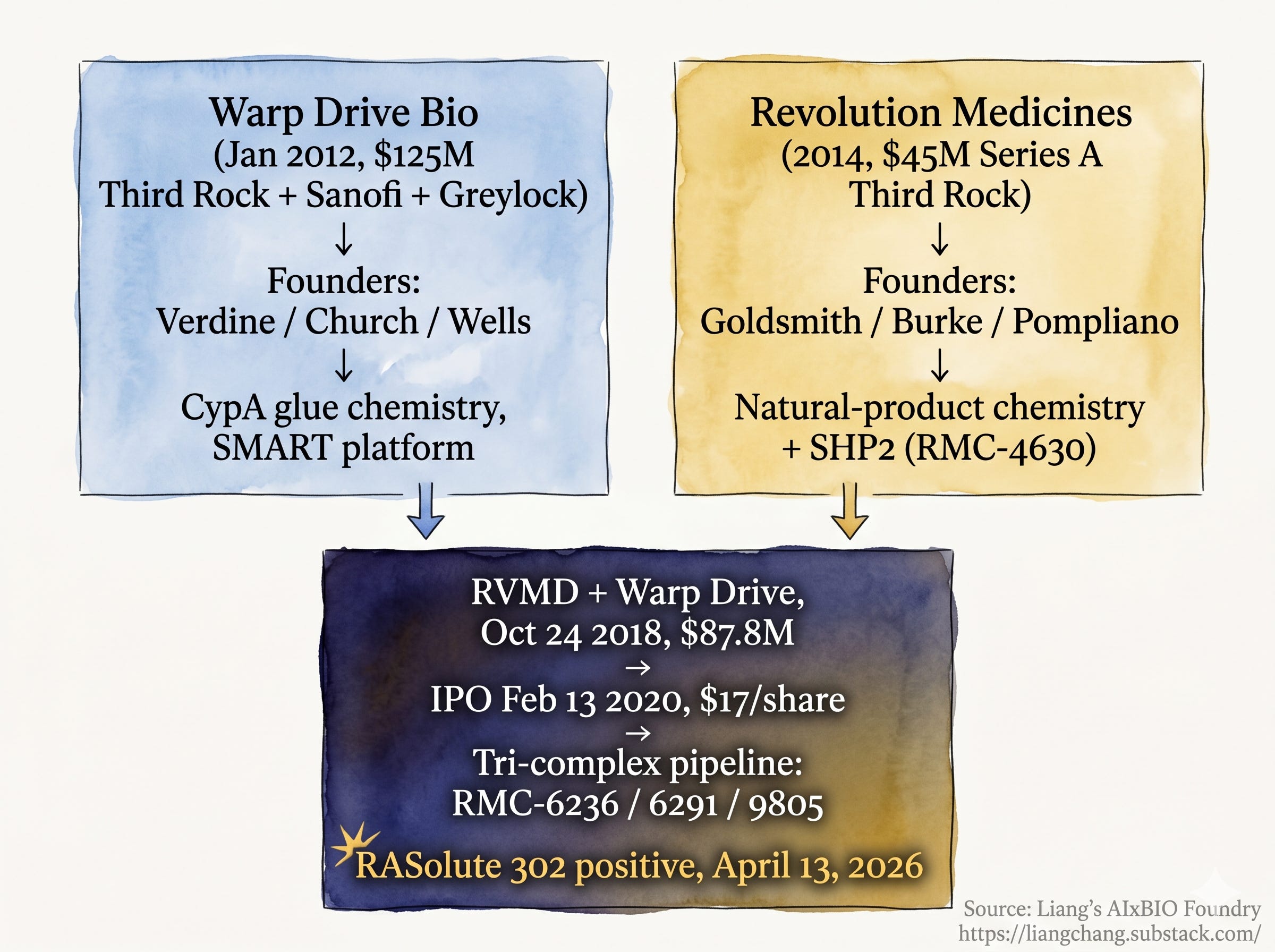
Revolution Medicines went public February 13, 2020. At IPO it was widely framed as the second-best KRAS story behind Mirati, whose adagrasib already had human G12Ci proof-of-concept. For roughly three years the scientific community did not buy the tri-complex thesis. Four objections showed up in reviews and analyst pieces:
Cyclophilin A is too ubiquitous. CypA is expressed at high levels in every cell, so a tri-complex inhibitor would hit CypA-wild-type-RAS-GTP everywhere and poison normal tissue.
Pan-RAS wild-type toxicity will be catastrophic. KRAS is essential in embryogenesis; pan-RAS inhibition in adult tissues was presumed to fail on tolerability.
Ternary complex stability will not hold in vivo. A non-covalent glue holding CypA plus KRAS-GTP together would collapse in plasma or have too short a residence time to matter.
Natural-product chemistry does not scale. Sanglifehrin-inspired macrocycles have 20-plus stereocenters; CMC was presumed prohibitive.
Every one of those concerns appears, in hindsight, to have been at least partially over-stated. The conditional neosurface creates mutant-selective engagement in practice because mutant KRAS spends disproportionately more time in GTP-bound state. The tumor-versus-normal kinetic window identified by Wasko/Singh et al. makes the pan-RAS math work in vivo. In-vivo ternary-complex persistence was demonstrated via target-engagement biopsies presented at AACR 2023 and 2024. And the chemistry appears scalable.
The tide turned at AACR-NCI-EORTC 2023, where Pasi Jänne presented the first elironrasib human data: NSCLC G12Ci-naïve ORR 43% (n=7), NSCLC G12Ci-pretreated ORR 50% (n=10). That second number is the one that functionally ended the skepticism. You cannot engineer post-G12Ci rescue from an OFF-state scaffold; it requires the ON state. Between AACR 2023 and AACR 2026, Revolution Medicines went from 1 abstract at AACR 2018 to 68 at AACR 2026, the first single meeting in the history of the field where one company’s KRAS abstract count exceeded Amgen’s and Mirati’s combined
The January 2026 buyout speculation is the capstone. The Financial Times reported on January 8 that Merck was in talks at a $28-32B valuation; the Wall Street Journal reported on January 25 that talks had ended over valuation gap. RVMD shares plunged roughly 20% on the January 25 news. CEO Mark Goldsmith addressed speculation at the JPMorgan Healthcare Conference on January 12.
On April 13, 2026, shares went up roughly 40% on RASolute 302 topline. A $32B offer that looked aggressive in January looks cheap now.
Era 5. The current era (AACR 2026, as a snapshot)
Multi-mutation, multi-state, multi-language
If you want the shortest possible description of where the field is as of publication week, it is the program grid at AACR 2026. My database confirms several structural shifts.
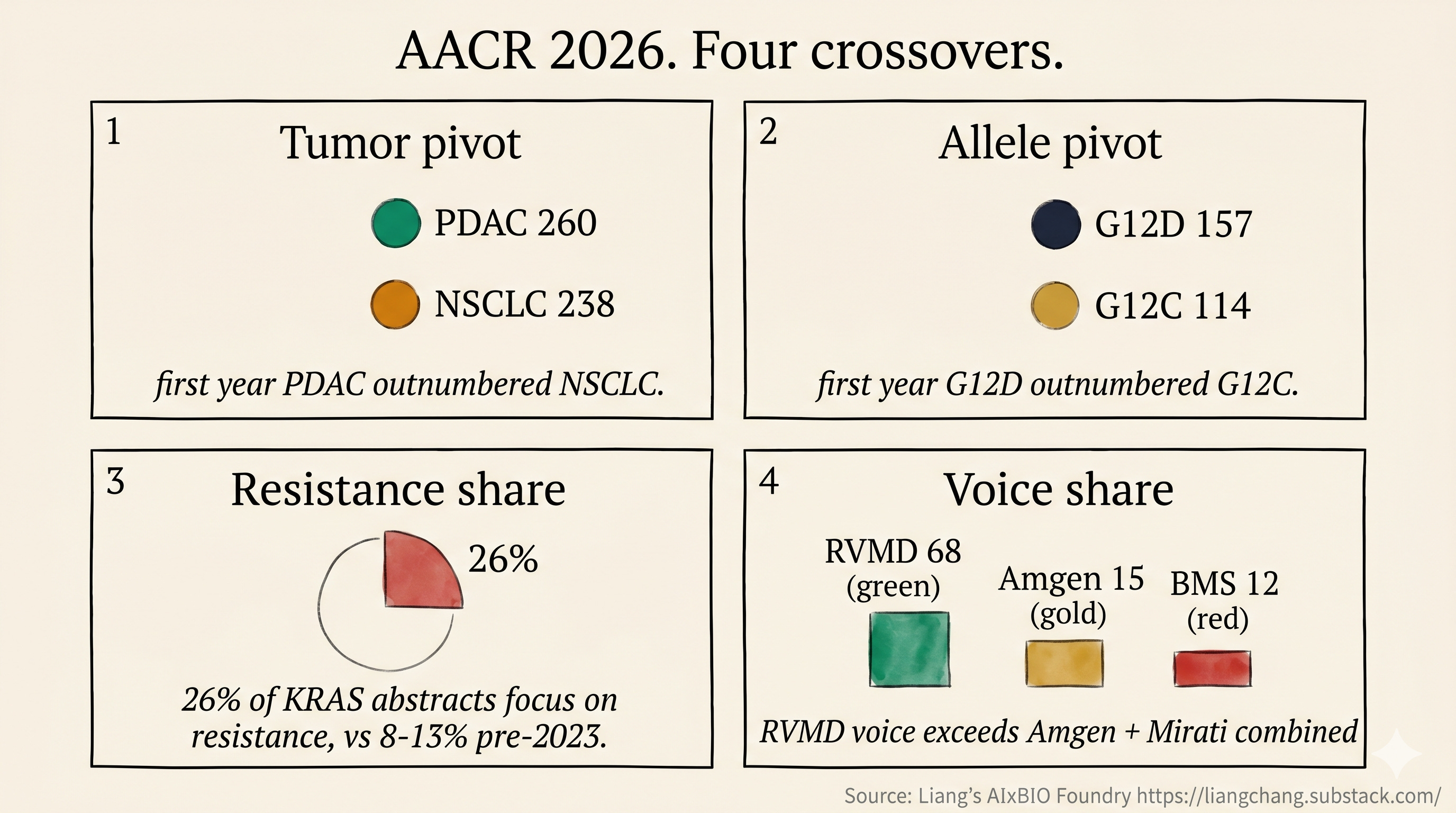
Voice share flipped at AACR 2026. Direct drug-title mentions: RVMD 21, Amgen 12, Mirati / BMS 6. Corresponding-author bylines: RVMD 7, Amgen 4, Mirati 1. The same ordinal ranking by both methods for the first time in the ten-year corpus.
Pan-RAS language grew from near-zero in 2020 to 112 AACR 2026 abstracts. Tri-complex, RAS(ON), multi-selective, and molecular-glue vocabulary has moved from Revolution’s internal language to the field’s default.
For the first time at AACR 2026, PDAC KRAS abstracts (260) outnumbered NSCLC KRAS abstracts (238). The center of gravity moved from the easy tumor to the hard one.
For the first time at AACR 2026, G12D abstracts (157) outnumbered G12C abstracts (114). The easy mutation is saturated with drug; the harder mutations now has four credible programs.
Resistance abstracts roughly quadrupled. 8 to 13% of KRAS abstracts in 2015 to 2022, 26% at AACR 2026 (274 abstracts), more than the prior six years combined.
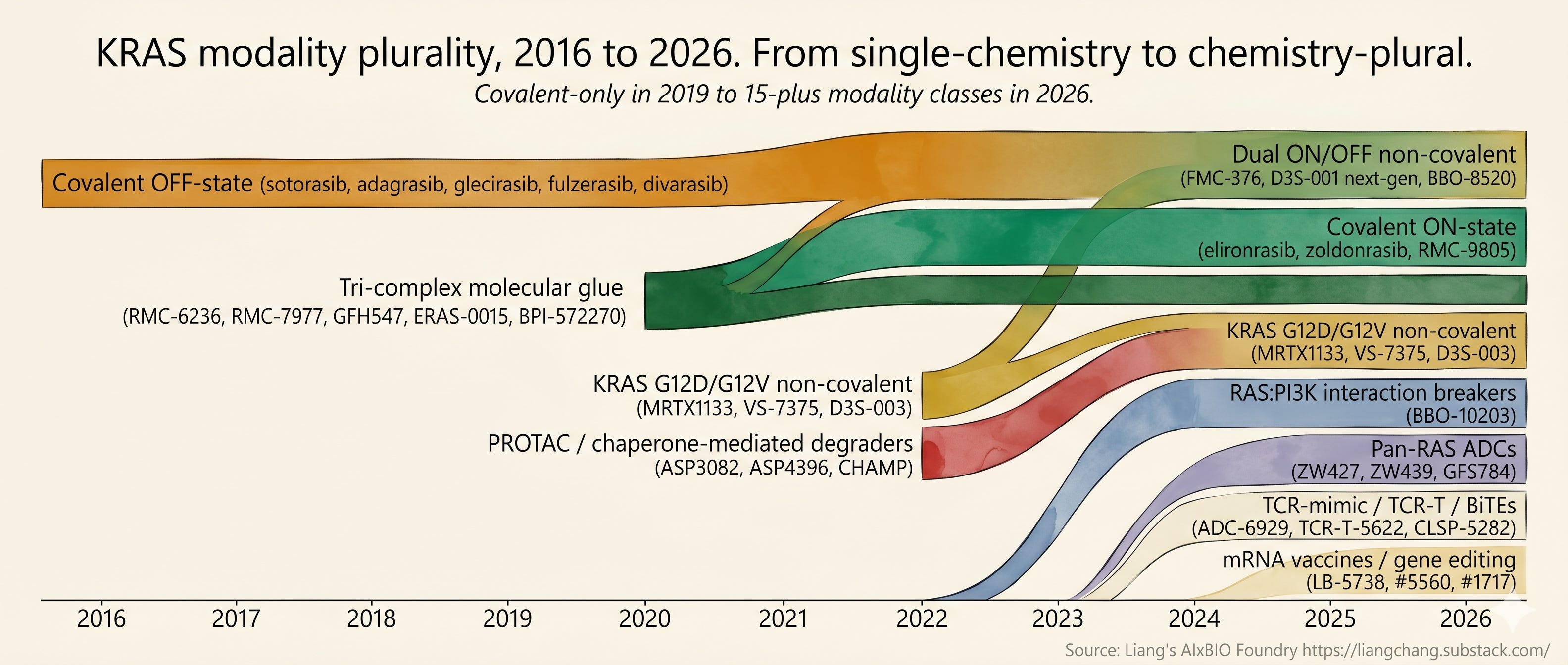
The 2026 AACR cycle has 15+ modality classes with live programs: covalent OFF-state, non-covalent OFF-state, covalent ON-state, non-covalent ON-state, dual ON/OFF, molecular glue, SOS1 allosteric, SHP2 inhibitor, PROTAC degrader, chaperone-mediated degrader, RAS:PI3K interaction breaker, pan-RAF/MEK molecular glue, pan-RAS ADC, TCR-mimic and TCR-T cell therapies, and mRNA vaccines. Covalent-only in 2019 → chemistry-plural in 2026. No single modality is winning.
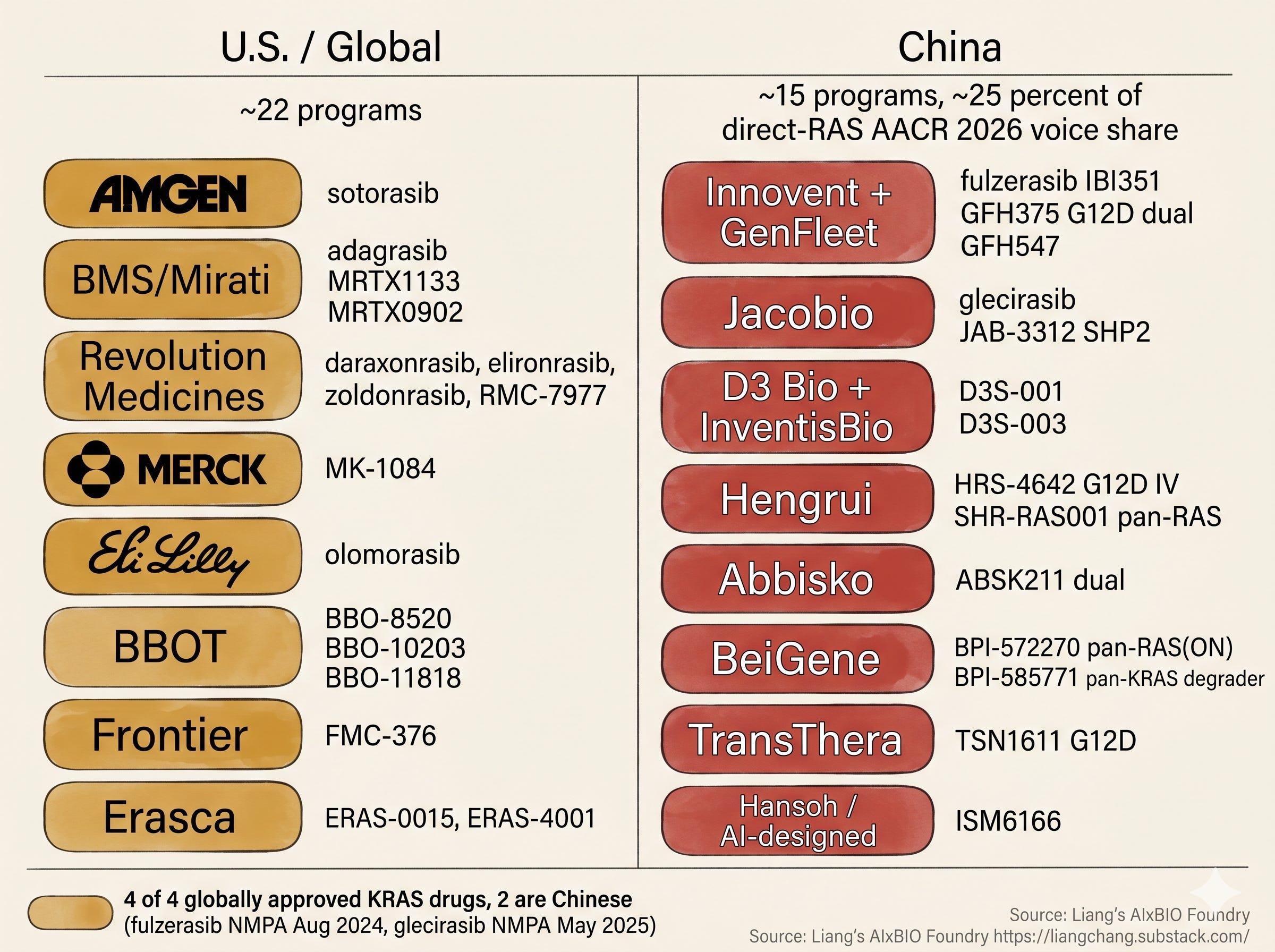
The geography. Two of the four global KRAS approvals are Chinese: glecirasib (Jacobio) in May 2025 and fulzerasib (Innovent, ex-GenFleet GFH925) in August 2024. Chinese biotechs GenFleet, Jacobio, InventisBio / D3 Bio, Hengrui, Abbisko, and BeiGene collectively account for roughly 25% of direct-KRAS abstract voice at AACR 2026. The two G12D programs with meaningful human data ahead of the American sponsors outside of Revolution’s RMC-9805 are Chinese: GFH375 / VS-7375 with two China Breakthrough Designations, and HRS-4642 (Hengrui) at 60% ORR in first-line PDAC with gemcitabine / nab-paclitaxel at ESMO 2025 (Abstract 2215O).
And the single most striking front-line combination signal in the 2024-2025 cycle may actually be the Chinese one. Innovent’s KROCUS trial (ASCO 2024 LBA8511) paired fulzerasib with cetuximab in 1L G12C NSCLC and reported ORR 80% and DCR 100% in n=34. That is a higher front-line ORR than any Western G12Ci + IO or G12Ci + chemo combination reported to date.
Era 6. What’s next (2026 to 2030)
Winning modality. Molecular glue looks likely to own pan-RAS, because only a glue can recruit a chaperone to a surface that no classical small-molecule binder can find alone. Covalent inhibitors and glues are fighting to own mutant-selective. G12D through covalent warhead chemistry (eg. MRTX1133) or ON-state covalent chemistry (eg. zoldonrasib) is an open question the next 18 months will resolve. We are waiting for more data to mature for pan-RAS ON/OFF glue and PROTAC degraders.
Winning tumor types. NSCLC G12C monotherapy appears to have hit its ceiling. The 1L combination with checkpoint inhibition (MK-1084 plus pembrolizumab) is probably the new ceiling for that mutation. CRC needs EGFR combination. PDAC is Revolution Medicines’ thesis and it just delivered with RASolute 302. Endometrial, biliary tract, and gastric could get niche (or umbrella?) responseapprovals. The interesting 2028 question is whether a pan-RAS drug finds an indication the field is not currently looking at where the biology cooperates.
Resistance. Genetic resistance to G12C OFF-state drugs (switch-II pocket mutations like Y96D, KRAS amplification, pathway reactivation through NRAS, BRAF, MET) might probably get solved by next-generation drugs or combinations. D3S-001 shows 30% ORR in sotorasib or adagrasib-pretreated NSCLC. Divarasib covers more of the pocket. Elironrasib attacks the ON state, orthogonal to acquired OFF-state mutations.
Adaptive non-genetic resistance is the harder half. YAP/TEAD transcriptional hyperactivation, mucinous or squamous trans-differentiation, EMT, lineage plasticity. None of these show up in cfDNA but make cancer no longer as-KRAS-dependent
Therapeutic window for pan-RAS. The number I am watching from RASolute 302 and its successors is grade 3+ adverse events attributable to wild-type RAS inhibition. The topline language was “no new safety signals,” which is a positive read on the safety package. But the safety margin will determine its march toward front line and across multiple mutations
The G12D door. Zoldonrasib (RMC-9805) at 61% ORR (n=18) in NSCLC G12D at AACR 2025 is the strongest G12D signal anywhere in the field. GFH375 (GenFleet) has two China BTDs. MRTX1133 is the covalent G12D drug that appears in my own 2021 qualifying-exam deck. Three programs are plausible Phase 3 entrants by 2027.
I will close with Marchio 2026, which is the one line of the year for this field:
Precision oncology began with mutations. Its future lies in multidimensionality.
40-years from Harvey’s rat sarcoma to RASolute 302. From the dark age to the plethora of assets. We are fortunately at the beginning of the new era to make KRAS druggable.
If it took 40 years to increase survival from 6 months to 12 months by targeting a presumed key culprit, is there maybe something missing in causal models of the disease?
Great work, really enjoying your writing!